Why You Run Out of Air Before You Run Out of Legs
Quick Answer: Bracing for a barbell requires holding air, and holding air conflicts directly with breathing. In a metabolic workout you cannot brace maximally on every rep, so you need a deliberate breathing point in the cycle - usually at the least demanding position. Find the pattern before the workout. Trying to sort it out at rep nine is how sets end early.
The legs were fine.
The air ran out, because bracing and breathing want the same thing and you never decided how to share it.

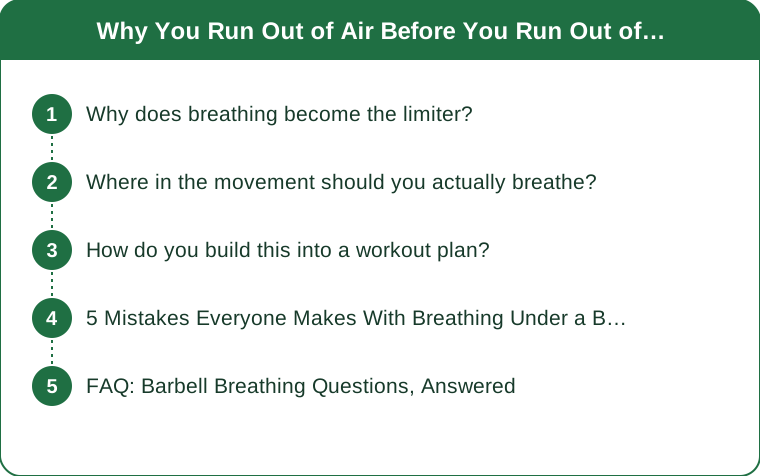
Why does breathing become the limiter?
Because the same mechanism that stabilises your spine also stops you breathing.
Bracing means holding air against a closed or partly closed airway. That intra-abdominal pressure is what protects your spine under load, and it is genuinely necessary for heavy lifting. You cannot brace hard and breathe freely at the same time - the two are mechanically opposed.
In a heavy single, that is fine. One rep, one breath held, then breathe. The conflict never arises because there is no repetition to sustain.
In a twenty-rep set, it is the whole problem. Twenty reps at the same bracing intensity means twenty breath holds and very little actual breathing. Your oxygen demand is rising while your breathing rate is falling, which resolves in exactly one way.
Effort tends to override technique. As a workout gets hard, people brace harder rather than smarter, and the breathing gets more restricted precisely when it is needed most. The instinct makes it worse.
And the recovery is slow once you are behind. Getting back on top of your breathing mid-workout takes much longer than staying on top of it. The deficit compounds across the following rounds.
The strain sensation is not the same as heavy legs. People describe it as gassing out, but the specific feeling is respiratory rather than muscular. Recognising which one stopped you is the first step to changing it.
Where in the movement should you actually breathe?
At the least demanding point, and it varies by lift.
Find the position where spinal load is lowest. In most barbell cycling movements there is a moment - usually at the top, at full lockout - where the spine is in a stable, stacked position and the demand momentarily drops. That is your breathing window.
Overhead movements breathe at lockout. With the bar supported overhead and the trunk stacked, a quick breath is available and costs nothing in stability. Short, sharp breaths at the top rather than one deep one.
Front rack movements breathe at the top of the stand. The front rack restricts the ribs, so the breath has to be taken deliberately in the standing position before descending. The rack position is the constraint that makes this lift the hardest to breathe under.
Deadlift-pattern movements breathe at the top, or briefly at the bottom with the bar down. A touch-and-go set removes the bottom option, which is one reason touch-and-go is more metabolically punishing than singles. The breathing cost is part of why, not just the lack of rest.
Keep the breaths short and rhythmic. One quick breath per rep, taken at the same point every rep, works far better than gasping every third rep. Rhythm beats volume when the window is small.
And practise it at light weight. The pattern has to be automatic before it will survive rep fifteen of a hard workout. Building it during warm-up sets is where it actually gets learned.

How do you build this into a workout plan?
Break sets at planned points, and pace by breathing rather than by legs.
Break the set before the breathing collapses, not after. A planned break at rep eight with controlled breathing is faster overall than pushing to twelve and needing forty seconds to recover. The break costs less than the recovery does.
Use the transition to breathe deliberately. The walk between the bar and the next station is breathing time, and most people waste it moving fast and breathing shallowly. Slow the transition and breathe deeply - it is usually a net gain.
Pace by your breathing in the first round. If you are already behind on air in round one of five, the workout is decided. Breathing status is the best early pacing signal available and better than how the legs feel.
Choose a weight that lets you keep a rhythm. A load that forces maximal bracing on every rep is too heavy for a metabolic workout, regardless of whether you can lift it. Scaling for breathing is a legitimate and underused reason to scale.
Nose breathing during transitions can help some people. It slows the rate and encourages fuller breaths, which is useful when the instinct is to gasp. Not universal, but worth testing.
And do not train through dizziness or lightheadedness. Breath holding under load can cause both, and pushing on is not the move. Put the bar down, and if it happens repeatedly or comes with chest discomfort or fainting, get it checked. This is general information, not medical advice.
5 Mistakes Everyone Makes With Breathing Under a Barbell
Bracing maximally on every rep of a long set. Appropriate for a heavy triple, self-defeating for twenty reps. Match the brace to the load rather than using one setting for everything.
Trying to take one big breath instead of several small ones. The window in a moving set is short, and a large breath needs more time than you have. Short and frequent beats deep and rare in this context.
Only breathing when you notice you need to. By the time you notice, you are already behind, and catching up mid-set is much harder than staying ahead. The pattern should be automatic, decided before rep one.
Sprinting the transitions. Running between stations feels productive and costs you the breathing time you needed. The transition is a resource, not dead space.
Choosing a weight based on strength alone. If a load forces you to brace maximally every rep, it is too heavy for a workout with a clock on it. The scaling question is about rhythm, not one-rep max.
And the bonus mistake: holding your breath through the transition too. People finish a set, walk to the next station, and only start breathing properly when they arrive. Start breathing the moment the bar lands.
FAQ: Barbell Breathing Questions, Answered
Should I ever hold my breath in a workout?
For a genuinely heavy rep, briefly, yes - bracing serves a real purpose. For high-rep metabolic work, no - that is where the pattern needs to change.
Why do I get dizzy during heavy sets?
Breath holding under load raises pressure and can affect blood flow and blood pressure momentarily. Occasional mild lightheadedness at genuinely heavy weights is common, but repeated dizziness, greying vision, or fainting is worth getting checked out.
Does this get better with fitness?
Partly - better aerobic fitness raises the ceiling. But the pattern is a skill, and the athletes who never learn it stay limited by it regardless of how fit they get.
TL;DR:
- Bracing and breathing are mechanically opposed - you cannot do both maximally at once.
- Pick one breathing point per rep, at the least demanding position, and take short sharp breaths there.
- Front rack positions restrict the ribs, so take the breath standing before you descend.
- Break sets before the breathing collapses - a planned break costs less than the recovery does.
- Pace by breathing status in round one, and scale the weight for rhythm rather than for strength.
In your next warm-up set, pick your breathing point and take a breath at exactly that spot on every rep. Ten light reps to build the pattern, and the workout version arrives already trained.
Keep Reading
This article is for general informational and styling purposes only. Fit, sizing, and product availability may vary.