Why the September Class Time Switch Changes Your WOD Times
Quick Answer: Moving from evening to morning classes when school starts costs most people 3 to 8 percent on strength and a similar hit on repeat-effort work — body temperature, joint stiffness, and hormonal state all sit lower at 6am than at 6pm. It is real, it is temporary, and it shrinks with about two to four weeks of consistent training at the new time plus a warm-up roughly twice as long as the one you used in the evening.
The kids go back, the schedule moves, and suddenly a benchmark you owned in July feels like somebody added twenty pounds to the bar.
You did not detrain in nine days. You changed the clock.

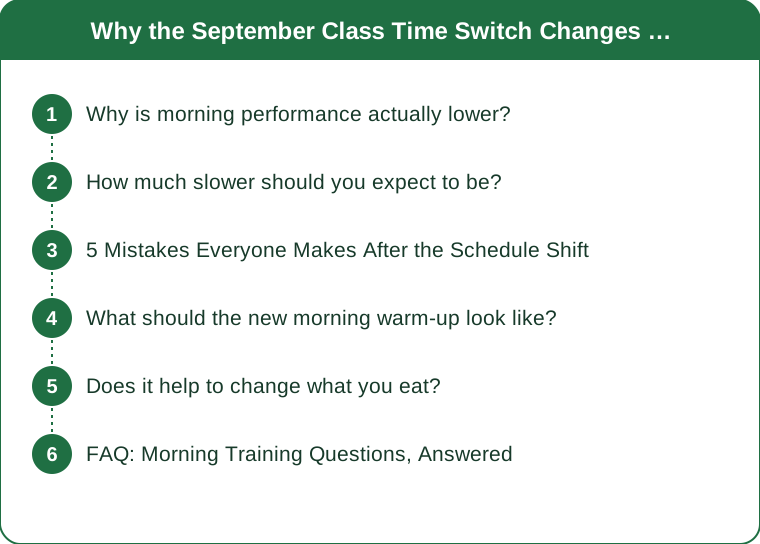
Why is morning performance actually lower?
Because several separate systems are all at their daily low point at once, and they stack.
Core temperature. Your body temperature follows a daily rhythm with a trough in the early morning and a peak in the late afternoon. Muscle contracts faster and more forcefully when it is warm. That single factor explains a large share of the gap, and it is also the one you have the most control over.
Joint and tissue stiffness. Spinal discs are at their most hydrated on waking, which means the spine is stiffer and slightly longer first thing. Overhead positions and deep squats both feel more restricted at 6am than they will at noon.
Hormonal state. Cortisol peaks shortly after waking, testosterone is high but the ratio between them is less favourable for output, and the whole system is oriented toward waking up rather than toward maximal effort.
Sleep inertia. For the first 30 to 60 minutes after waking, reaction time and coordination are measurably impaired. If you roll out of bed at 5:35 for a 6:00 class, some of that is still running during your first working set.
How much slower should you expect to be?
The honest range from the research on time-of-day effects:
- Maximal strength: roughly 3 to 8 percent lower in the early morning versus late afternoon
- Peak power and jump height: often a slightly bigger gap, because explosive output is more temperature-sensitive than grinding strength
- Repeat-effort conditioning: variable, but most people report the first two to three minutes feel disproportionately hard
- Absolute endurance: smallest effect, which is why a long easy row feels close to normal while a heavy clean does not
On a benchmark WOD, that adds up quickly. A workout that took 9:40 in the evening plausibly takes 10:15 to 10:30 at 6am with identical fitness. The clock on the wall is not lying to you and neither is your body — you are just comparing two different physiological states and calling them the same test.
The practical consequence: stop comparing morning scores to evening scores. Start a fresh column.
5 Mistakes Everyone Makes After the Schedule Shift
1. Keeping the same warm-up. The single biggest error. Your evening warm-up worked because you arrived already warm from a day of moving. At 6am you arrive at your daily temperature minimum. Double it — 12 to 15 minutes minimum, and the goal is to break a light sweat before you touch a loaded barbell.
2. Chasing the old number in week one. You will miss, and missing under fatigue at low body temperature is where the tweaks happen. Give it three weeks before you test anything.
3. Not shifting bedtime. Waking two hours earlier while going to bed at the same time is a sleep-restriction protocol, not a schedule change. Sleep debt costs you far more than the time-of-day effect does — and it compounds, while the time-of-day effect adapts.
4. Training fasted by accident. Evening training happens after two or three meals. Morning training often happens after none. For a short session it is fine; for a 20-minute metcon it is not. Even 20 to 30 grams of carbohydrate 30 minutes out changes the back half of the workout.
5. Assuming it will not adapt. It does. The time-of-day gap narrows substantially when you consistently train at the same early hour, because body temperature rhythm partially shifts to anticipate the session. That is the whole reason to be patient.

What should the new morning warm-up look like?
Longer, warmer, and front-loaded with general work before anything specific.
Phase 1 — raise temperature (5 to 7 minutes). Easy bike, row, or ski at a genuinely easy pace. Not a warm-up piece for time. The target is warm skin and slightly elevated breathing, nothing else.
Phase 2 — move every joint (3 to 4 minutes). Ankles, hips, thoracic spine, shoulders. Full range, unloaded, controlled. This is where the stiffness gets addressed, and it works far better after Phase 1 than before it.
Phase 3 — specific ramp (5 minutes). The movements in the workout, at a fraction of the load, adding weight over four or five sets. Take more warm-up sets than you would in the evening — an extra light set costs 90 seconds and buys you the first working set.
Phase 4 — one short primer. Three to five quick, sharp reps at close to working intensity. This wakes up the nervous system, which is the last thing to come online.
A practical detail: keep your layers on longer than feels necessary. Staying warm between sets in a cold September gym is doing real work, and stripping to a tank at 6:05am is working against you.
Does it help to change what you eat?
Somewhat, and the changes are small and specific.
- Something before, even if small. A banana, a piece of toast, a scoop of carbohydrate in water. The goal is to stop the session from running on an overnight-fasted liver.
- Caffeine earlier and slightly larger. Caffeine has been shown to blunt part of the morning performance deficit — it is one of the few interventions that directly addresses the time-of-day gap rather than working around it. Take it 45 to 60 minutes before, not on the way in the car.
- Hydration matters more. You wake dehydrated after seven hours without fluid. Half a litre on waking is a genuine performance variable in the morning in a way it is not at 6pm.
- Do not overhaul dinner. Late heavy meals to “fuel tomorrow” tend to cost sleep quality, and sleep is worth more than the marginal glycogen.
This is general information, not medical advice — if you have a condition affected by fasted training or by caffeine, talk to your doctor rather than experimenting in a class.
FAQ: Morning Training Questions, Answered
How long until morning training feels normal?
Most people report the sessions feel normal in about two to four weeks of consistent early training, with the strength numbers following a little later. The adaptation is partly a shift in your temperature rhythm and partly just familiarity with the routine.
Should I re-test my benchmarks now or wait?
Wait. Testing in week one of a schedule change gives you a number that reflects the schedule, not your fitness, and then you spend a month chasing a bad data point. Re-test after three or four weeks and treat that as your new morning baseline.
Is evening training just better, then?
For peak output on a given day, generally yes by a small margin. For actual results over months, the session you consistently attend beats the session that is theoretically optimal and gets skipped twice a week. Consistency wins by a much larger margin than the time-of-day effect.
Why do some people feel great in the morning?
Chronotype varies substantially, and genuine morning types show a much smaller time-of-day gap. If you have always woken early and felt sharp, you will likely find the switch easier than the person who has been training at 7pm for five years.
TL;DR:
- Expect roughly 3 to 8 percent off strength and slower metcon times when you move from evening to early morning classes.
- Body temperature, joint stiffness, sleep inertia, and hormonal state are all at their daily low at 6am.
- Double your warm-up, take extra ramp sets, stay layered up, and eat something small beforehand.
- The gap narrows in two to four weeks of consistent early training — do not re-test benchmarks in week one.
Start a separate column for morning scores. Comparing them to your July evening numbers is the fastest way to talk yourself out of a schedule that otherwise works.
Keep Reading
This article is for general informational and styling purposes only. Fit, sizing, and product availability may vary.