Why Your Grip Fails Before Your Back in High-Rep Workouts
Quick Answer: Grip fails first in high-rep work because it is doing sustained isometric work while everything else gets brief unloading between reps. Your back contracts and relaxes; your hands never let go. Add sweat, a thick bar and a heavy set of pull-ups earlier in the workout, and grip becomes the limiter well before your posterior chain does.
The set says 21 deadlifts. Around rep 13 the bar starts sliding, and by 16 you have to drop it.
Your back feels fine. Your legs feel fine. Your hands are open and will not close.
That is not weakness. It is a different kind of fatigue, and it responds to different fixes.

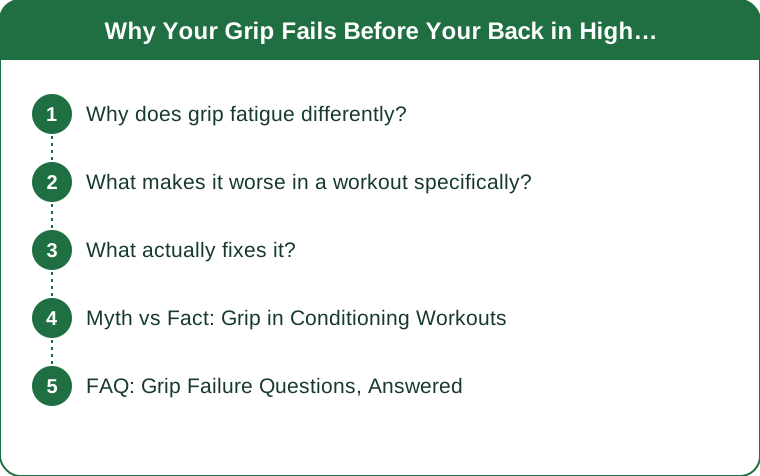
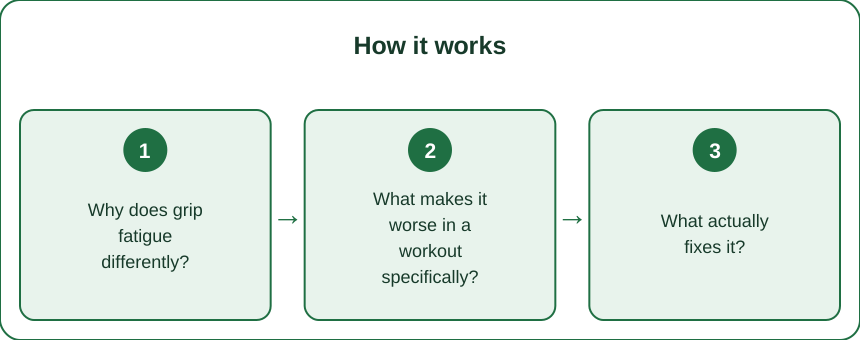
Why does grip fatigue differently?
Because it is the only muscle group in the movement doing continuous work.
During a set of deadlifts, your glutes, hamstrings and back contract on the way up and get a brief release at the top and bottom. Blood flows, the muscle unloads for a fraction of a second, and it resets.
Your forearm flexors get none of that. From the moment you grip the bar to the moment you let go, they are in sustained isometric contraction. And sustained contraction restricts blood flow through the muscle itself — the contraction squeezes the capillaries, which limits oxygen delivery and metabolite clearance exactly when demand is highest.
So grip accumulates fatigue on a completely different curve from the prime movers. The rest of you is doing intervals. Your hands are doing a wall sit.
That also explains the recovery pattern: grip comes back fast. Ten or fifteen seconds with your hands open and you can usually grip again, while a genuinely fatigued posterior chain needs minutes. If your hands recover in fifteen seconds and your back does not, that tells you which one was really limiting.
What makes it worse in a workout specifically?
Several things, and most of them are ordering and equipment rather than strength.
Prior grip work. Pull-ups, toes-to-bar, hangs, kettlebell work and rowing all tax grip heavily. If the workout put those before the barbell, your grip arrived pre-fatigued. This is the most common cause and it is entirely a programming artifact — your grip strength did not change, it just already worked.
Sweat. Hands get slick, so you grip harder to compensate, which fatigues you faster. The effect is nonlinear: a slightly slippery bar costs a lot more than a slightly heavier one.
Bar thickness and knurling. A thicker bar or worn knurling both increase the force needed for the same security. A bar with no bite is genuinely harder to hold.
Touch-and-go reps. Cycling reps without setting down means the grip never releases, and the bounce at the bottom adds a dynamic load the hands have to absorb. Touch-and-go is faster and considerably more grip-expensive than singles.
Over-gripping. Under fatigue people squeeze harder than necessary, which accelerates the failure. Some of what feels like a grip limit is a technique response to anxiety about dropping the bar.

What actually fixes it?
In-workout tactics first, then training.
Use a hook grip. Thumb against the bar, fingers over the thumb. It is genuinely uncomfortable for the first few weeks and it is substantially more secure than a standard overhand grip, because it uses bone and skin friction rather than pure finger flexion. Most people who commit to it for a month never go back.
Break the set before you fail. If a set of 21 will cost your grip at 16, plan 12 and 9 with a short reset. A ten-second break with the hands open restores far more than it costs, and it prevents the failed rep and the panic that follows.
Chalk, and dry your hands. The cheapest fix on the list. Chalk reduces the required grip force meaningfully, and re-chalking mid-workout is time well spent.
Use straps where the rules allow. For heavy pulling where grip is not the training target, straps let you train the movement you are actually trying to train. In competition they are usually not allowed, which is a reason to train grip, not a reason to avoid straps in general work.
Alternate grip on heavy singles, hook grip for volume. Mixed grip is secure for singles but introduces asymmetry, and it is not ideal for high-rep cycling.
Then actually train grip. Two or three times a week, at the end of a session:
Dead hangs — accumulate 2 to 3 minutes total, broken into sets. The most direct and effective option.
Farmer’s carries — 3 sets of 30 to 40 meters heavy. Builds both grip endurance and everything that holds you upright under load.
Plate pinches or heavy holds — 3 sets of 20 to 30 seconds. Cheap and effective.
Grip responds quickly to training — many people see a noticeable difference within four to six weeks.
Myth vs Fact: Grip in Conditioning Workouts
Myth: Failing grip means your grip is weak. Fact: Usually it means your grip was pre-fatigued by earlier movements or that the set was too long to hold continuously. Maximum grip strength and grip endurance are related but not the same quality.
Myth: Straps are cheating. Fact: Straps are a tool for training the movement when grip is not the target. Using them for every set of everything will limit grip development, which is a real trade-off — but so is never being able to load your back properly.
Myth: Chalk is mostly psychological. Fact: Chalk absorbs moisture and increases friction, both of which measurably reduce the force needed to hold a bar. It is one of the highest-value pieces of equipment in the gym.
Myth: Hook grip damages your thumbs. Fact: It is painful initially and the skin toughens. Persistent joint pain is worth attention, but the discomfort most people describe in the first weeks is adaptation, not injury.
Myth: You should train grip to failure often. Fact: Forearms recover fast but the connective tissue around the elbow does not, and aggressive daily grip work is a common route to medial elbow pain. Two or three sessions a week is plenty. This is general information, not medical advice.
FAQ: Grip Failure Questions, Answered
How do I know if it is really grip and not my back?
Drop the bar, open your hands for fifteen seconds, and try again. If you can pick it right back up, it was grip. If it still feels heavy, your posterior chain was involved too.
Should I plan my breaks or go until failure?
Plan them, every time. A planned break costs seconds; a failed rep costs a reset, plus the disruption of getting back into position. Nearly every experienced athlete breaks sets before failure in high-rep work.
Does grip strength matter outside the gym?
Substantially — grip strength is one of the more studied correlates of general strength and health outcomes. It is also the thing that limits carrying, hanging and pulling in ordinary life.
Why do my forearms cramp?
Sustained maximal isometric work in a fatigued muscle, often with dehydration on top. Ease the grip pressure, break the set, and check your fluid intake if it is happening regularly.
Is a thicker bar better for training grip?
Fat-bar work builds grip effectively and taxes it much faster, so use it deliberately in accessory work rather than in a workout where you need the bar to move.
TL;DR:
- Grip does sustained isometric work while your back and legs get micro-rests each rep — and sustained contraction restricts its own blood flow.
- Failure is usually pre-fatigue from earlier movements, sweat, or touch-and-go reps rather than weak hands.
- Fix it in the moment: hook grip, chalk, and planned breaks before failure rather than after.
- Train it two or three times a week: dead hangs to 2 to 3 minutes, heavy farmer’s carries, plate pinches.
- Test which failed by opening your hands for fifteen seconds — if you can grip again, grip was never the strength limit.
Your back had more in it. Your hands just ran a different race and finished first.
Keep Reading
This article is for general informational and styling purposes only. Fit, sizing, and product availability may vary.