Why Your First CrossFit Competition Nerves Feel Worse Than Any WOD Ever Did
Quick Answer: Pre-competition nerves spike because you’re waiting with nothing to do — unlike a normal WOD where movement starts the second the clock does, competition day has hours of standing around, which lets anxiety build unchecked.
You’ve done the workout in training a dozen times. You know the movements, the weights, the pacing. So why does your heart rate hit 140 just standing behind the start line? It’s not fitness — it’s the waiting.

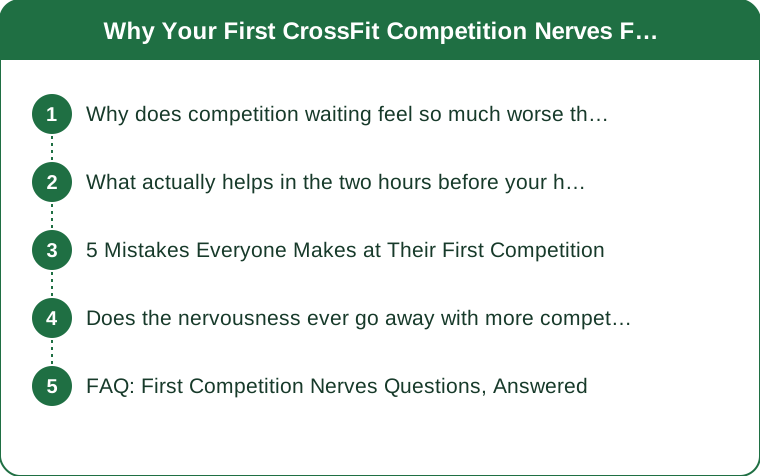
Why does competition waiting feel so much worse than the workout itself?
In a normal training WOD, you walk in, warm up, and start within 20-30 minutes. At a competition, you might check in two hours before your heat, then stand around a floor watching other athletes go, with nothing to physically do about the nervous energy building up.
That idle time is the real enemy — your body produces adrenaline whether you’re moving or not, and without an outlet, it just accumulates into shaky hands and a racing mind.
What actually helps in the two hours before your heat?
Keep your body doing something low-key the entire time — light movement, easy mobility work, walking laps around the venue — anything that gives the adrenaline somewhere to go besides your stomach.
Many competitors also do a mini version of their actual warmup 20 minutes before their heat is called, not just once at check-in, so their body feels primed rather than cold and anxious.

5 Mistakes Everyone Makes at Their First Competition
Mistake 1: Watching every single heat before yours. Comparing yourself to athletes you’re not competing against just adds anxiety with zero benefit.
Mistake 2: Changing your warmup routine because ‘this feels different.’ Stick to what you know works in training — competition day is the wrong time to experiment.
Mistake 3: Skipping food because you’re too nervous to eat. Low blood sugar plus nerves is a rough combination for performance.
Mistake 4: Arriving with no plan for the dead time. Idle waiting is where nerves spiral — have a mobility routine ready to fill it.
Mistake 5: Treating the first movement of the workout as the scary part. The actual first rep almost always calms nerves down — it’s the anticipation, not the execution, that’s hard.
Does the nervousness ever go away with more competitions?
It fades but rarely disappears completely — most experienced competitors describe it as becoming more manageable and familiar rather than gone, similar to how any repeated high-stakes activity gets easier with exposure.
What changes most is your relationship to the feeling: veteran competitors learn to read pre-competition nerves as readiness signals rather than warning signs, which takes real pressure off.
FAQ: First Competition Nerves Questions, Answered
Is it normal to feel nauseous before a competition?
Yes — mild pre-event nausea from adrenaline is extremely common and typically fades once you start moving; staying lightly hydrated and avoiding a heavy meal right before helps.
Should I tell my judge or teammates I’m nervous?
Many competitors find saying it out loud actually reduces the internal pressure — there’s no downside to being honest about it with people in your corner.
How early should I arrive to avoid rushing but limit waiting time?
Most coaches suggest arriving with enough time for one full warmup cycle before your heat, not hours early — extra idle time tends to amplify nerves rather than reduce them.
TL;DR:
- Pre-competition nerves come from idle waiting time, not the workout itself
- Keep your body lightly moving throughout the wait instead of standing still
- Stick to your normal training warmup — don’t experiment on competition day
- The feeling fades with experience but rarely disappears entirely
Your first competition nerves aren’t a sign something’s wrong — they’re just adrenaline with nowhere to go yet. Give it somewhere to go.
Keep Reading
This article is for general informational and styling purposes only. Fit, sizing, and product availability may vary.