Subbing the Rower for the Bike Erg Is Not a Fair Trade (Here Is the Conversion)
Quick Answer: Calories are the only unit that converts reasonably across ergs, and even then the bike erg produces calories faster than the rower for most people - typically 20-30% faster at a comparable effort. Meters never convert. If you must substitute, match by time or calories, and expect the bike version to be more leg-dominant and less taxing on your grip and back.
The whiteboard says 1,000m row. The rower is taken, the bike erg is free, and you have twelve minutes before the class starts.
So you do 1,000m on the bike, finish way faster, and log the same time next to everyone else’s.
That substitution changed the workout in three ways, and only one of them was the number.

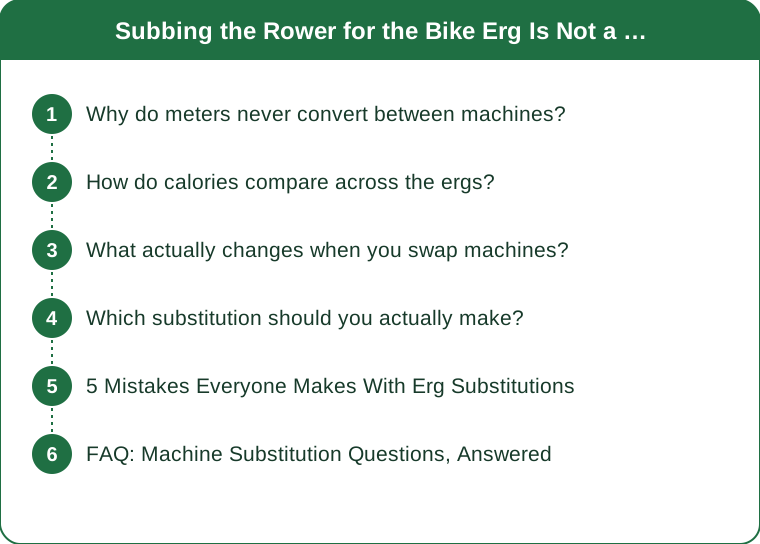
Why do meters never convert between machines?
Because each machine calculates distance from a completely different physical model. A rower converts flywheel deceleration into a virtual boat speed. A bike erg models a rider against wind resistance. A ski erg models yet another thing entirely.
The practical outcome is that 1,000m on a bike erg takes most people around 90 seconds and 1,000m on a rower takes around 4 minutes. Those are not the same workout, and no amount of scaling makes the meter units comparable.
This is why programming that offers machine substitutions almost always specifies calories rather than distance. Calories are a measure of work output, which is at least the same kind of quantity across machines.
If your gym’s whiteboard gives a meters-only prescription, the honest substitution is time-based: row for the time the workout intends, on whatever machine you have.
How do calories compare across the ergs?
Calories are closer to fair but still not equal. At a matched perceived effort, most people find:
- Bike erg produces calories fastest - it is the highest calorie-per-minute machine at a hard effort for the majority of athletes
- Rower is next
- Ski erg is typically slowest, since it is the most upper-body dependent
A rough working conversion many gyms use is treating bike calories as roughly 1.2-1.3x rower calories for the same effort, meaning if the workout calls for 20 rower calories, the equivalent bike work is more like 24-26 calories.
The important caveat: these ratios vary enormously by body size and training background. A 200lb athlete with a cycling background will blow through bike calories. A lighter athlete who rows well may find the rower faster for them.
The only real answer is to test your own numbers: 3 minutes hard on each machine, once, and write down the calorie counts. Those are your personal conversion factors and they will not match anyone else’s.
What actually changes when you swap machines?
Not just the number. Three real differences:
Muscle recruitment. The rower is roughly 60% legs, 30% core and back, 10% arms through a full stroke. The bike erg is almost entirely legs with an arm contribution that varies with how hard you pull on the handles. Swapping a rower for a bike in a workout that also has heavy deadlifts removes a lot of accumulated posterior chain fatigue - which makes the workout easier in a way the clock will not show.
Grip and forearms. Rowing loads the grip continuously. In a workout with pull-ups or barbell cycling, the rower is a genuine grip tax that the bike erg is not. This is often the single biggest difference in how a workout feels.
Transition cost. Getting on and off a rower with feet strapped in costs meaningful seconds per round. In a workout with many short intervals, that adds up and the bike is faster to enter and exit.

Which substitution should you actually make?
Match the machine to what the workout is trying to do:
- Workout has heavy pulling or lots of grip work? The bike erg is the kinder substitution and often the smarter one even if a rower is free.
- Workout is testing a full-body engine? The rower or ski erg is closer to the intent. Substituting the bike makes it a leg workout.
- Workout has short, repeated intervals? The bike wins on transition time and is easier to hit consistent output on.
- Workout is long and steady? Any machine works. Pick the one you can hold form on for the duration.
- You have a lower back that is already fatigued? The bike, without hesitation.
And tell whoever is scoring. A substituted machine is a scaled workout, not the prescribed one, and pretending otherwise makes your own training log useless six months from now.
5 Mistakes Everyone Makes With Erg Substitutions
1. Converting meters directly. The most common error and the one that turns a 4-minute piece into a 90-second one.
2. Assuming the damper setting is comparable. Rower damper and bike erg resistance are not the same scale. A damper of 5 on a rower is a drag factor around 120-130 for most machines; bike ergs use a different system entirely.
3. Substituting to avoid a weakness. If you always swap out the rower, the rower stays your weakness forever. Substitute for equipment availability, not preference.
4. Forgetting the transition seconds. In a 21-15-9 workout, machine entry and exit can account for 30-45 seconds of the total. That is not nothing when you are comparing to a friend’s time.
5. Not recording the substitution. Six months later you find a great score in your log and cannot remember it was on a different machine.
FAQ: Machine Substitution Questions, Answered
Is the bike erg easier than the rower?
For most workouts, yes - not because it takes less effort, but because it fatigues fewer systems. You can hold a hard bike effort with a tired back and grip in a way you cannot on a rower.
What about the air bike versus the bike erg?
Completely different machines. The air bike includes arms and gets exponentially harder as you go faster, which is why calories on an air bike are the slowest to accumulate of any machine at moderate effort and among the most brutal at high effort.
How do I substitute a run?
A rough starting point many gyms use is 400m run to 500m row or 400m run to 1,000m bike erg. As with everything here, test your own numbers - running economy varies far more between people than erg output does.
TL;DR:
- Meters never convert between machines. Calories convert approximately; time converts best of all.
- The bike erg typically produces calories 20-30% faster than the rower at matched effort.
- Swapping the rower for the bike removes grip, back, and posterior chain load - which changes the workout beyond the clock.
- Choose the substitution based on what the rest of the workout demands, not on preference.
- Log the substitution or your training history becomes fiction.
Every box has an unspoken machine hierarchy and every athlete has a personal one. Test your own three-minute numbers once, write them on the inside of your notebook, and stop guessing at the whiteboard.
Keep Reading
This article is for general informational and styling purposes only. Fit, sizing, and product availability may vary.