How to Actually Strategize a Partner WOD Instead of Just Winging It
Quick Answer: Effective partner WOD strategy means splitting work based on each partner’s relative strengths rather than even splits by default, using short, frequent switches to keep both partners near peak output, and front-loading the harder movements while both partners are freshest.
You and your partner just alternated evenly through the whole WOD like always, and finished slower than teams that clearly planned their splits. Even splits feel fair — they’re rarely fastest.

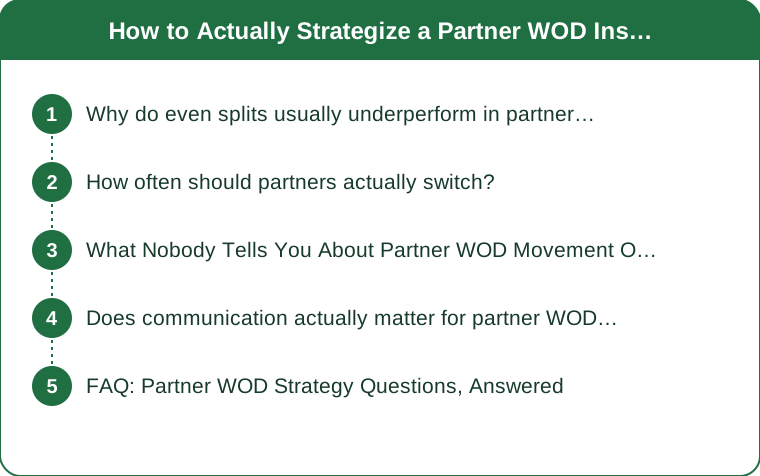
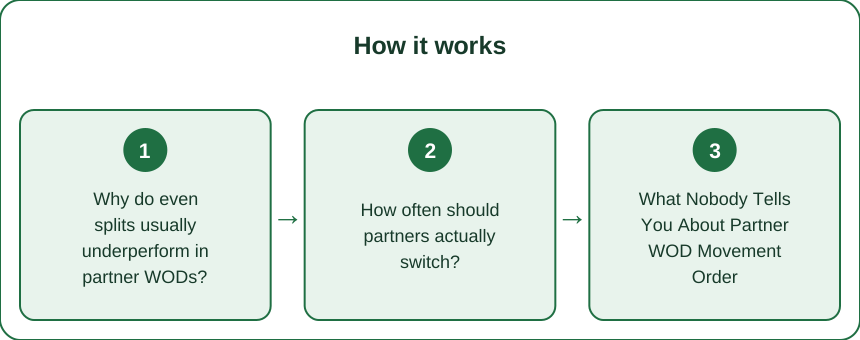
Why do even splits usually underperform in partner WODs?
Alternating evenly (you do 10, I do 10) ignores that partners are rarely equally strong at every movement in a workout — one partner might be notably faster at the barbell movement, the other stronger on gymnastics reps.
Splitting work proportionally to relative strength — the stronger partner takes a bigger share of their strong movement — usually beats even splits for total time, even though it feels less ‘fair’ in the moment.
How often should partners actually switch?
Shorter, more frequent switches generally beat long, exhausting sets for total workout speed, since fatigue accumulates non-linearly — the last few reps of a long set are typically much slower than the first few, so cutting sets short before major fatigue keeps both partners closer to peak output throughout.
A common effective pattern is switching every 30-60 seconds or every 5-10 reps on moderate-to-heavy movements, adjusting shorter as the workout progresses and fatigue builds.

What Nobody Tells You About Partner WOD Movement Order
Here’s the strategic piece most teams skip: front-load the hardest or most technical movement while both partners are freshest, rather than saving it for when fatigue makes technical breakdown and injury risk both higher.
If the WOD structure allows any choice in ordering, tackling your team’s weakest shared movement early — while form and focus are both sharpest — usually saves more total time than pushing through it exhausted later.
Does communication actually matter for partner WOD speed?
More than most teams account for. A quick pre-workout agreement on exact switch points (rep counts, not vague ‘until tired’) removes mid-workout hesitation and negotiation, which quietly costs real seconds across a full workout.
A simple verbal cue system — a specific word or tap to signal ‘switching now’ — keeps transitions fast and prevents the awkward few seconds of unclear handoffs that add up over a longer workout.
FAQ: Partner WOD Strategy Questions, Answered
Should the stronger partner always do more reps?
Generally yes for movements where the strength gap is significant, but balance it against fatigue management — a stronger partner doing 80% of a movement alone can still burn out faster than a well-planned split.
How do you plan strategy for a partner WOD you’ve never seen before?
Agree on general principles beforehand (short switches, front-load technical work, stronger partner takes more of their strength) so you can apply them quickly once you see the actual workout.
Does partner WOD strategy matter more for longer workouts?
Yes — strategy compounds over time, so a 20-minute partner WOD rewards good planning far more than a 5-minute sprint where raw effort matters more than pacing.
TL;DR:
- Split work by relative strength per movement, not automatic even splits
- Shorter, more frequent switches beat long sets for total workout speed
- Front-load the hardest or most technical movement while both partners are fresh
- Agree on exact switch cues beforehand to avoid costly mid-workout hesitation
Next partner WOD, spend 60 seconds planning splits before the clock starts — it usually saves more than 60 seconds by the finish.
Keep Reading
This article is for general informational and styling purposes only. Fit, sizing, and product availability may vary.