How to Pace a WOD So You Stop Blowing Up at Minute Four
Quick Answer: Blowing up in a WOD is a math error made in the first ninety seconds: you spend at sprint rates in a workout priced in minutes, local muscles and breathing hit their ceiling, and everything after minute four becomes damage control. The fix is deciding your pace before 3-2-1-go: read the time domain, break sets before you need to, hold a conversational-minus-one effort through the first third, and negative-split the back half. The fittest person in the room is usually the one moving slowest at minute one and fastest at the end.
Every workout asks a question. Round one hot is answering before you heard it.

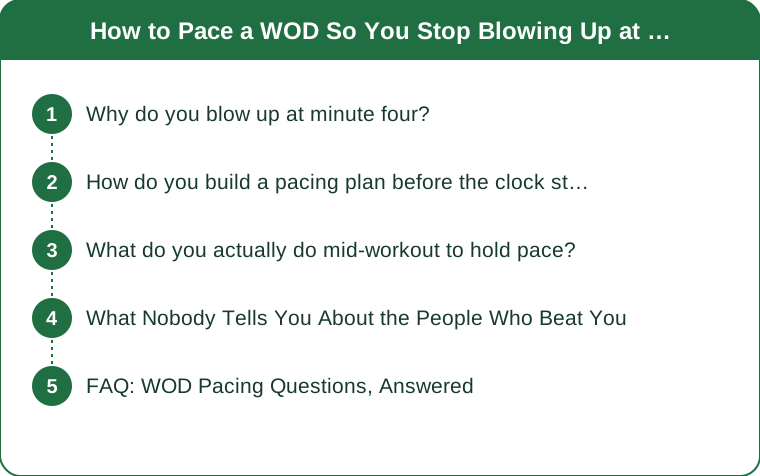
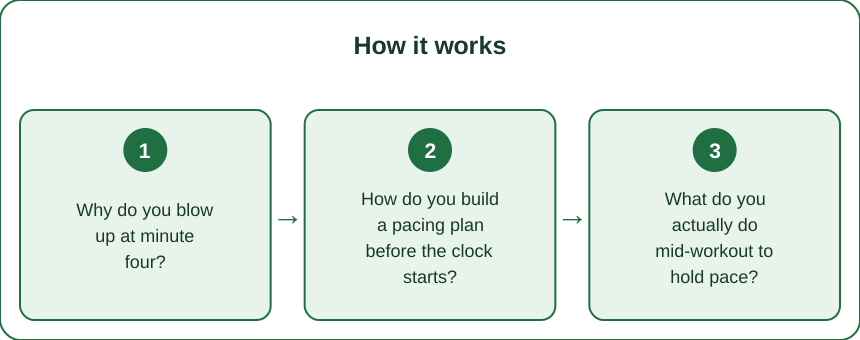
Why do you blow up at minute four?
Because the first ninety seconds lie, and the debt they hide compounds fast.
Fresh plus adrenaline masks true cost. At 3-2-1-go you are rested, buzzed, and surrounded by peers — the opening pace feels sustainable because nothing has been paid for yet. Effort debt arrives on a delay: the burpees of minute one invoice you at minute three.
Sprint-speed work runs on fast-burning fuel with a hard ceiling. Push past the intensity you can sustain and you shift into deeply glycolytic territory — the legs-full-of-concrete, lungs-on-fire state every CrossFitter knows by name. Once there, recovery inside a workout is slow and partial. The blow-up is not fatigue accumulating gradually; it is a cliff you either pace above or fall off.
Local muscle fatigue cliffs are even sharper. Grip in high-rep pulling, shoulders in overhead work, forearms on the bar — burn out a local muscle group and no amount of cardio fitness buys the reps back. An unbroken first round of pull-ups is frequently the direct cause of the singles you are doing in round three.
Heart rate has a ceiling too, and redlining early parks you there. Blow to near-max in minute two and every subsequent movement is performed on top of maxed cardiac output — transitions stop being recovery because there is nothing left to recover with.
The cruel arithmetic: the seconds gained by a hot first round are tiny; the minutes lost standing hands-on-knees after the blow-up are huge. Almost every metcon PR story is a slower start, not a faster one.
How do you build a pacing plan before the clock starts?
Read the time domain, do the set-break math, pick your effort anchor. Three minutes of thinking that beats twenty minutes of suffering.
Step one: name the time domain honestly. Estimate your realistic finish — not the whiteboard leader’s. Under 5 minutes: high aggression is allowed. Eight to fifteen: the classic trap zone — start at what feels like 70 percent. Fifteen-plus or a long AMRAP: settle into all-day pace from the first rep and let the workout come to you. Most blow-ups are sprint pacing applied to a twelve-minute question.
Step two: break sets before you need to. Plan splits while fresh, using the two-thirds rule: if you could do 15 unbroken right now, work in sets around 10 — or smaller. Sets of 21 become 8-7-6; wall balls become planned 10s with three breaths between. Short planned breaks cost five seconds; the unplanned two-minute stare at the bar costs the workout. Grip-heavy and shoulder-heavy movements get the most conservative splits, because local burnout is unrecoverable.
Step three: pick the effort anchor for the first third. The reliable cue: conversational-minus-one — you could speak a short sentence, unhappily. If you could not gasp out your own name at minute three, you are past the cliff edge. Breathing is the honest gauge when reps feel deceptively smooth.
Step four: assign the transitions. Decide in advance where the breaths happen — three breaths at the bar, five steps to the rower, chalk once per round, no bonus wandering. Transitions are either designed recovery or leaked time; the plan decides which.
Then trust it for three minutes. The plan will feel too easy in round one. That feeling is the plan working — everyone who passed you is a rebate check scheduled for minute nine.

What do you actually do mid-workout to hold pace?
Breathe on purpose, move smoothly, and spend your surplus only at the end.
Drive the breathing instead of chasing it. Exhale on effort — out of the squat, off the box, at the press — and use planned breaks for deliberate slow exhales rather than panic panting. The moment breathing turns ragged, the next set gets smaller, immediately. Two fewer reps per set now is the cheapest purchase in fitness.
Make the reps boringly smooth. Frantic reps — bounced deadlifts, flailed burpees, crashing barbells — burn extra energy and invite no-reps. Smooth, positioned, slightly-metronomic movement is faster over ten minutes than fast-and-ugly is over three. In a long sweaty metcon, gear that stays put helps more than it should: squat-proof leggings and a sports bra that need zero mid-round adjusting are one less tax on your attention.
Run a check-in every round: breathing — can I say a sentence? Grip and shoulders — is a local group nearing its cliff? Split — am I ahead of or behind round one’s time? Even splits or slight negative is the target; a round-two collapse of 30-plus seconds means the sets shrink now, not next round.
Negative-split the back half. Hold the conservative gear through the middle, then — final third, when the finish is arithmetic instead of hope — shorten breaks first, then extend sets. The last 90 seconds is where the reserve gets spent completely. Finishing with a sprint you banked feels like the opposite of blowing up, because it is.
Afterward, log the splits, not just the time. Round times tell you exactly where pacing broke, and three workouts of notes will teach your personal cliff edge better than any article.
This is general training guidance. Chest pain, dizziness, or anything beyond normal hard-workout distress means stop and get checked — no metcon is worth it.
What Nobody Tells You About the People Who Beat You
The fittest athlete in the room is often slowest at minute one. Watch the veterans in a long metcon: they look almost lazy in round one, pass everyone in round four, and sprint the finish. They are not being modest — they priced the workout correctly and are collecting on everyone who did not.
Unbroken is usually a vanity purchase. Big unbroken sets early feel impressive and torch the local muscle groups the workout was designed around. Planned 8-7-6 with crisp transitions routinely beats heroic 21s followed by singles. The whiteboard does not award style points for how round one looked.
Resting before you need to is the actual advanced move. Three breaths taken while you still feel fine keep you above the cliff; the same three breaths taken after ragged breathing arrives buy back almost nothing. Pre-paying rest is counterintuitive and it is the whole trick.
Transitions are where whole minutes hide. Walking to chalk twice a round, re-tightening everything, staring at the bar — leaked time no fitness can recover. The plan-your-breaths athletes gain 40 seconds a workout while appearing to hurry nowhere.
Scaling load fixes pacing more often than discipline does. If the prescribed weight forces sets so small the workout becomes rest, the stimulus is gone — the right scale keeps you moving at the intended rhythm, which is the entire point of the piece.
And everyone has blown up. Minute-four death is a universal CrossFit rite, not a character flaw. The difference between year one and year three is not toughness; it is that year-three you does the set-break math during the whiteboard brief.
FAQ: WOD Pacing Questions, Answered
How hard should the first round actually feel?
Suspiciously manageable — a conversational-minus-one effort where a short sentence is possible but unpleasant. In workouts over eight minutes, if round one felt satisfyingly hard, you almost certainly overpaid for it.
When should I break my sets if I feel fine?
Before you need to, on the plan you made while fresh — roughly two-thirds of your current unbroken capacity, smaller for grip and shoulder movements. Feeling fine is precisely when cheap rest is available; ragged is when it stops working.
How do I pace an AMRAP versus a rounds-for-time workout?
AMRAPs reward metronome pacing: find a repeatable round time early and hold it, sprinting only the final minute. For-time pieces allow slightly more aggression with a planned negative split. Both are lost, identically, in an overheated first two minutes.
Is it bad to finish feeling like I had more in the tank?
Once in a while, yes — it means the last third was underspent, and next time the finish push starts earlier. Every time, no: consistently finishing strong with even splits is the signature of correct pacing, and it is also how PRs actually happen.
TL;DR:
- Blowing up is a first-90-seconds pricing error: sprint spending in a minutes-long workout, cashed out as the minute-four cliff.
- Plan before the clock: read the time domain, break sets at two-thirds capacity, anchor the first third at conversational-minus-one.
- Mid-workout: breathe on purpose, keep reps smooth, shrink sets the moment breathing frays, and negative-split the back half.
- Log round splits — three workouts of data teaches your personal cliff better than any rule of thumb.
Next metcon, write your set breaks on the whiteboard before 3-2-1-go. Round one will feel too easy, and minute nine will explain why that was the plan.
See It in Motion
Seen here: Super High Waist Embossed Yoga Leggings with Inner Pocket — shop it on bubblelime.com
Keep Reading
This article is for general informational and styling purposes only. Fit, sizing, and product availability may vary.