Why Going Out Fast Costs You More Than It Ever Gains
Quick Answer: Going out fast pushes you above the intensity your aerobic system can sustain, which forces heavy anaerobic contribution early. The metabolic byproducts that produces do not clear while you keep working, so every subsequent round runs at a deficit. The 15 seconds you gain in round one typically costs 45 to 90 seconds across the rest of the workout, plus the transitions you spend standing still.
Everybody knows this and almost everybody does it anyway. Here is the mechanism, which is more persuasive than the advice.

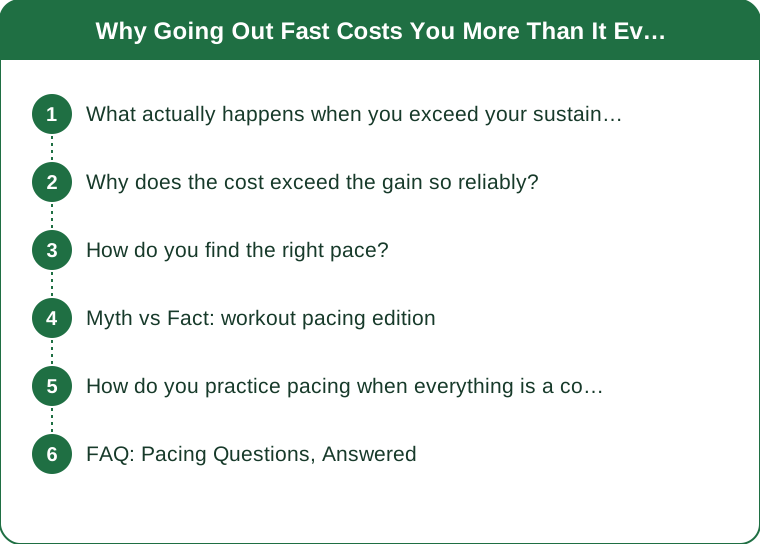
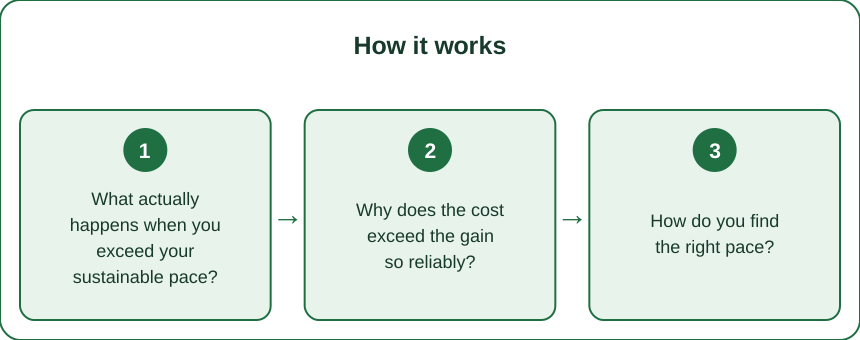
What actually happens when you exceed your sustainable pace?
Your body has two broad ways to produce energy quickly: aerobic, which is sustainable but rate-limited, and anaerobic, which is fast but produces byproducts that accumulate.
Below a certain intensity — roughly your critical power or lactate threshold — you can clear those byproducts as fast as you produce them, and you can hold that state for a long time. Above it, accumulation outpaces clearance, and you are on a clock.
Crucially, the deficit does not reset between rounds. Once you are in accumulation, only genuine rest clears it, and mid-workout you are not resting. So a fast first round does not just tire you; it moves you into a state you spend the rest of the workout paying for.
Why does the cost exceed the gain so reliably?
Because the loss is not linear. When you are deep in accumulation, your ability to sustain even a moderate pace collapses, and — this is the expensive part — your transitions get longer.
Watch anyone who went out too hard. The reps themselves slow somewhat. What really costs them is the 20 seconds standing over the barbell before picking it up, and the walk instead of the jog between stations. Those pauses are where the time actually disappears, and they are invisible in the moment because they do not feel like a decision.
Technique degrades too, which costs both time and reps. A no-rep in round four because your form fell apart is a direct transfer of the seconds you gained in round one, with interest.
How do you find the right pace?
The most useful practical rule for a workout longer than about five minutes: your first round should feel comfortably repeatable, close to your target pace for the whole thing.
A better test is negative splitting. If you can run the second half faster than the first, you paced it correctly. Almost nobody manages this, which tells you something about how common the error is.
Break sets before you need to, especially on the first round. Doing 12-8 on a set of 20 in round one feels unnecessary and is exactly what lets you do 12-8 again in round four instead of 8-5-4-3.
For a workout you have done before, take your previous total time, divide by rounds, and add 5 seconds to your target first round. That deliberate slowness is almost always faster overall.

Myth vs Fact: workout pacing edition
Myth: You can bank time early. Fact: There is no bank. Time gained above threshold is borrowed at a punishing rate and repaid within two rounds.
Myth: Fitter athletes just push harder throughout. Fact: Watch elite fields — they are notable for how even their splits are. Their threshold is higher, and they still stay under it.
Myth: Short workouts are the exception. Fact: Under about 3 minutes, going out hard is often correct because you finish before accumulation fully bites. The rule applies to everything longer.
Myth: Pacing means holding back. Fact: Correct pacing produces your fastest possible time. It is the opposite of holding back — it is spending your total capacity efficiently instead of dumping it in the first 90 seconds.
How do you practice pacing when everything is a competition?
Assign yourself a target and score the workout on how close you came to even splits rather than on total time. Do this for one workout a week.
Use a clock deliberately. Note your round times as you go, not afterward. You cannot pace what you are not measuring, and memory of how a round felt is unreliable within 30 seconds of finishing it.
Practice the uncomfortable version: deliberately go out 10 seconds slower than feels right on a workout you have done before. Almost everyone who does this once posts a personal best and is annoyed about it.
And train at threshold specifically. Intervals of 3 to 8 minutes at a hard-but-sustainable effort raise the pace you can hold without accumulating, which is the only way to actually go faster rather than just distributing better.
FAQ: Pacing Questions, Answered
Does this apply to strength work too?
Differently. Heavy strength work is limited by neural fatigue and recovery between sets rather than metabolite accumulation. Rest periods matter more there than pacing does.
How do I pace when I do not know the workout in advance?
Use the first round to gather information at a deliberately conservative effort, then adjust. A slightly slow first round costs far less than a fast one.
Is it ever right to sprint the finish?
Yes, and that is the reward for correct pacing. If you have a real sprint available in the final round, you paced it well. If the final round is survival, you did not.
TL;DR:
- Above threshold, byproducts accumulate faster than you can clear them, and mid-workout there is no clearing.
- Most of the lost time shows up as long transitions, not slow reps.
- Break sets in round one before you need to.
- If you can negative split, you paced it right — and almost nobody can.
The fastest people in most gyms are not the ones who look hardest in the first two minutes. They are the ones still moving at the same speed in the last two, which is a strategy long before it is a fitness level.
Keep Reading
This article is for general informational and styling purposes only. Fit, sizing, and product availability may vary.